
Our AI Can Handle Anything, Even Trolls
watson tried to push the Alimentarium in Vevey’s conversational agent to its limits. What happened was more revealing than any technical benchmark.
Forty years of research, five languages, zero guesswork
A Swiss journalist spent an hour trying to find a weakness in Alima, the Alimentarium in Vevey’s conversational agent. He failed. Here is why.
When Boris Wastiau, Director of the Alimentarium, first shared his vision for the project with Ask Mona, one thing was clear: he was not looking for yet another digital tool. He wanted an agent capable of faithfully conveying forty years of scientific research on food, in five languages, to audiences with radically different expectations.
The Alimentarium is the only museum in the world to explore food and nutrition in such a comprehensive way. Deploying AI in this context means accepting that it will ultimately be judged on the quality and reliability of what it says, not on the novelty of the technology.
That requirement shaped the project from the outset. Alima does not rely on a general-purpose model pulling information from across the internet. It works exclusively from resources produced by the Alimentarium: its research, collections and exhibition content.
The agent knows exactly what it knows, and what it does not. It does not fill gaps with guesswork.
What the test revealed
In April 2026, journalist Fred Valet published an article in Swiss media outlet watson with a subtitle that made his intentions clear:
“We corrupted the new weapon of a famous museum in French-speaking Switzerland.”
The experiment involved asking Alima questions unrelated to the exhibition, testing its consistency and deliberately trying to provoke it.
From the outset, watson noted that Alima operates within a clearly defined scope: it answers questions exclusively based on exhibition content rather than the wider web. That is not a limitation. It is precisely how the experience was designed.
The conversations make this clear.
When the journalist asks Alima whether she knows Britney Spears, she politely declines to engage. Asked again, her tone changes:
“No. Let’s move on.”
Three words. No lecture, no surrender. The agent knows how to remain polite while setting boundaries.
The same consistency appears in more emotional interactions.
When a visitor says they feel anxious after seeing a photograph of refugees in Nigeria, Alima neither dismisses the emotion nor tries to act like a therapist: “If you’re starting to feel anxious, take a short break, breathe, and come back later. You could even spend a little time at the museum’s Paysage bar.”
watson also highlights Alima’s ability to adapt her tone in real time.
When Boris Wastiau asks her to explain something “as if to a ten-year-old,” the vocabulary changes, the sentences become simpler and the tone adjusts accordingly.
The person she is speaking to may have changed, but the underlying content remains the same.
What the test did not reveal
watson went looking for a flaw. What it found was a methodology.
None of the documented exchanges exposes an unexpected limitation. Instead, each one confirms that Alima knows exactly what she is, what she is there to do, and where her boundaries lie.
Boris Wastiau ends the article with a particularly telling observation:
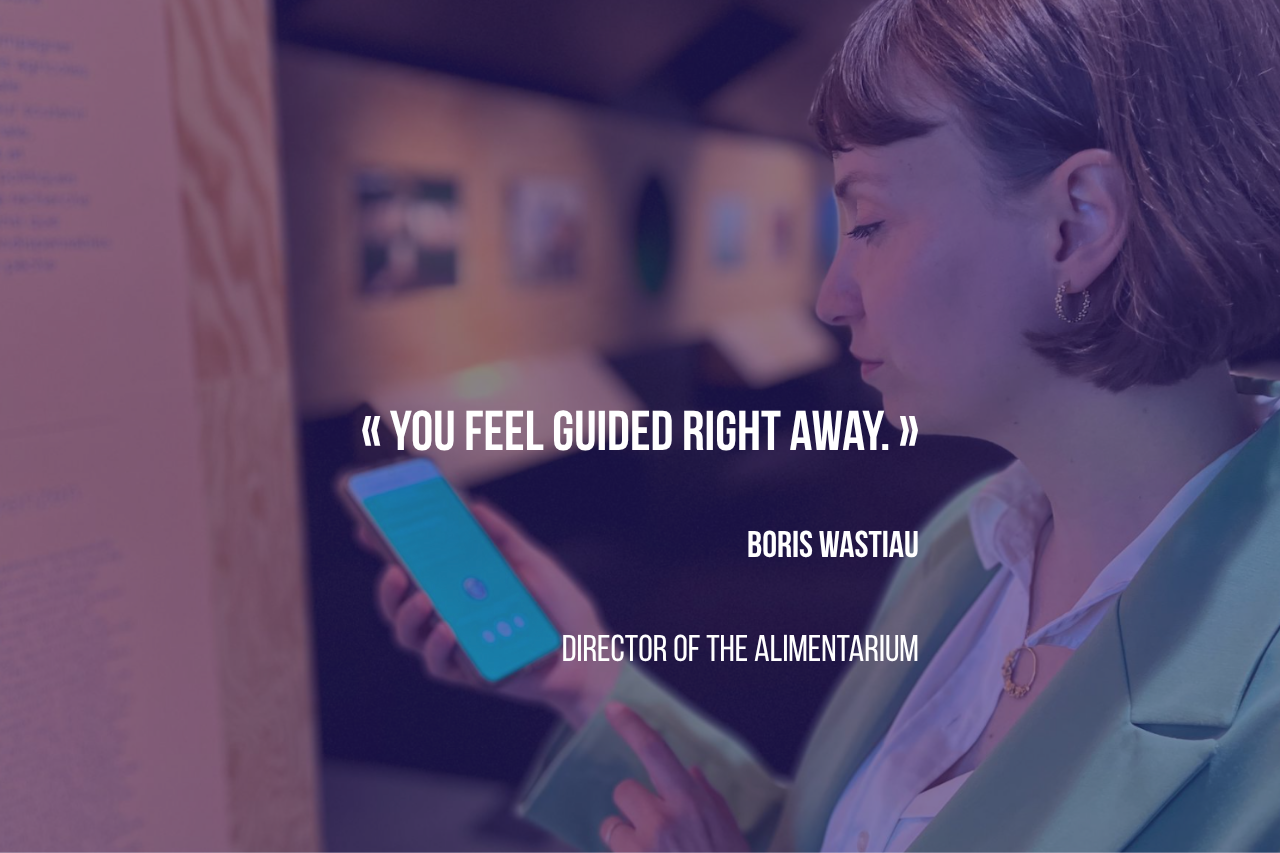
“An exhibition room can sometimes feel intimidating for certain visitors. With a tool like this, you feel guided right away.”
It is the assessment of a museum professional who has seen the experience work under pressure.
That is what eight years of real-world deployments with more than 200 cultural institutions have enabled us to build.
Every project starts from the same foundations: the institution’s content, its audiences, and the questions it genuinely wants its agent to be able to handle.
The watson article is available here: Alimentarium de Vevey: we tested the Alima chatbot (watson, Fred Valet, April 18, 2026).

What if your AI agent became a real touchpoint with your audiences?



Take the
next step