
“Enhancing the visitor experience without altering the site”: Château du Clos de Vougeot’s approach
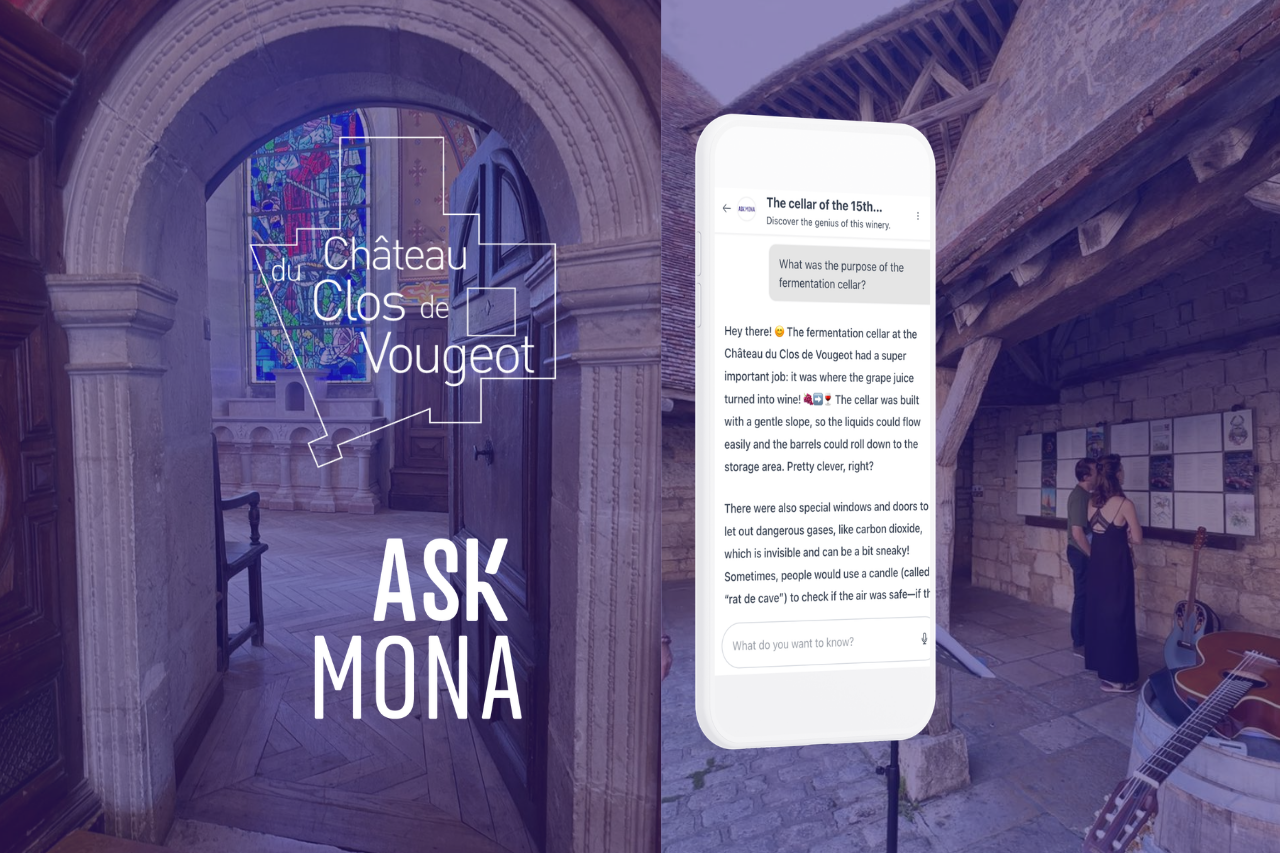
An interview with Pauline Marceaux, Head of Tourism and Wine Tourism at Château du Clos de Vougeot. She discusses the deployment of a conversational AI guide available in 10 languages, with two distinct experiences for adults and children, accessible directly from visitors’ smartphones with no app to download.
Founded in the 12th century by Cistercian monks, Château du Clos de Vougeot is one of Burgundy’s most iconic wine heritage sites. Its history attracts visitors from across Europe and beyond.
To share this heritage with such a diverse audience, the château already offered a range of interpretation tools, including printed guides, interactive displays, films and an audio guide available through a mobile app. With Ask Mona, it chose to complement these resources with a conversational AI guide accessible directly from visitors’ smartphones, available in ten languages and designed for both adults and children.
Ten languages, with no app required
Visitors do not need to download an app. They simply scan a QR code, select their language and start asking questions. The range of languages available played a key role in the decision to launch the project.
“Because we welcome such an international audience, the range of languages available immediately stood out to us. If our printed materials are not available in Italian, for example, visitors can turn to Ask Mona and ask their questions directly,” explains Pauline Marceaux, Head of Tourism and Wine Tourism at Château du Clos de Vougeot.
The experience is available in French, English, Spanish, Italian, German, Japanese, Dutch, Korean, Chinese and Portuguese.
A Japanese tourist and a Portuguese visitor can access the same content, validated by the château, each in their own language.

At Clos de Vougeot, history is no longer experienced in just one language. It is told in the visitor’s own.
Two experiences designed for adults and children
Personalisation also comes through two characters, each offering a different visitor journey.
Adults can speak with Dom Goblet, the estate’s last cellarer monk. Through their questions, they can explore the daily lives of the Cistercian monks, how their community was organised and the role they played in the winemaking history of Clos de Vougeot.
Children are accompanied by a young Gustave Eiffel. This second experience offers them a different way into the château’s history, adapted to their age and designed to spark their curiosity.
Clos de Vougeot can therefore engage different generations without offering everyone the same narrative.
Conversation allows each visitor to shape their own journey. An adult might explore the estate’s Cistercian history in greater depth, while a child asks Gustave Eiffel about something they have just discovered around them.
The experience adapts not only to the visitor’s language, but also to their age and personal interests.
Providing information exactly where curiosity arises
Conversations with the AI guide also help Clos de Vougeot identify which parts of the visit generate the most questions.
The 15th-century vat house and its two historic 14-ton wine presses are among the topics visitors ask about most frequently.
Yet this space deliberately contains very little explanatory signage. As soon as visitors enter, they encounter several striking features: the wine presses, an enigmatic statue and a model of the château made from 200,000 Lego pieces.
The team chose to preserve this visually rich environment rather than add further interpretation panels.
“Visitors are particularly interested in our 15th-century vat house and the old wine presses, where there is relatively little explanatory information. So they turn to Ask Mona and ask all their questions there,” says Pauline Marceaux.
The experience makes information available at the exact moment curiosity arises, without changing the exhibition design or adding new physical displays to the rooms.
This discretion was particularly important for Clos de Vougeot, as some of its spaces are also used for receptions and private events.
“We wanted to renew our interpretation approach with a tool that would preserve the character of the site completely,” explains Pauline Marceaux.
An experience managed directly by the Clos de Vougeot team
The platform also allows the Clos de Vougeot team to remain in control of the information visitors receive.
From the back office, they can review the questions visitors ask, identify the subjects generating the most interest and spot answers that could benefit from additional information.
Content can then be enriched or updated directly by the château. This flexibility is particularly useful when certain rooms are temporarily closed or when visiting conditions change.
“We really appreciated being able to access the back office and adjust the content whenever we want. It is easy to use and allows us to stay in control of the information we provide,” explains Pauline Marceaux.
Visitors’ questions therefore become a valuable source of insight for continuously improving the interpretation experience.
“When we see that an answer is only partial, we can adjust it, provide more information and fill in anything that may have been missing,” she adds.

Enhance the visitor experience with AI


Take the
next step