
Focus on "Museum AI Pledge: Keeping Human Expertise at the Center"
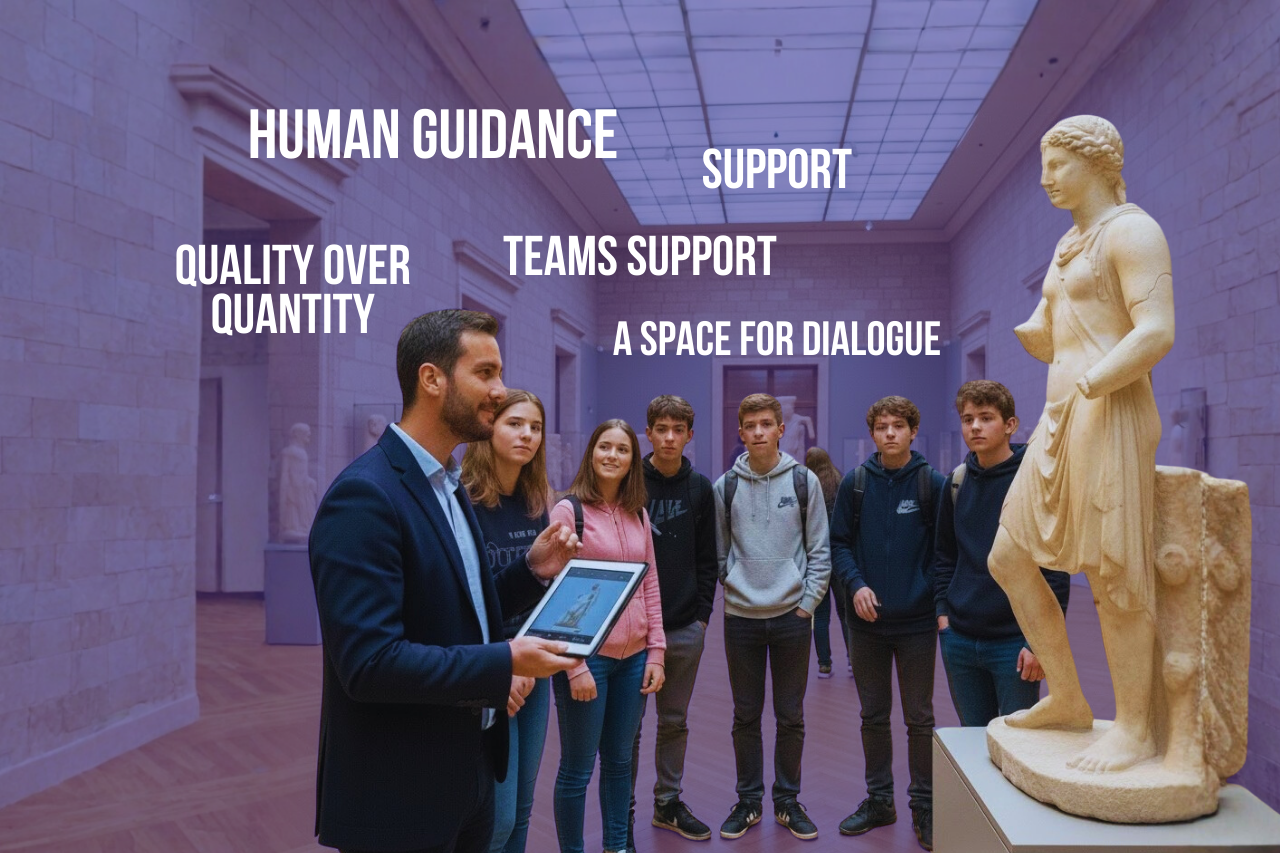
Museum AI Pledge: Keeping Human Expertise at the Center
Rethinking AI as a tool to support human expertise in museums
Artificial intelligence is increasingly present in the cultural sector, yet museums face both excitement and hesitation when it comes to adoption. The Museum AI Pledge, co-authored by Marion Carré and Adam Rozan, presents a framework for integrating AI in a way that respects human judgment and institutional values while exploring its potential to enhance engagement and interpretation.
These principles highlight that AI should augment human expertise rather than replace it, and that deliberate, thoughtful use can create richer experiences for both professionals and audiences.
About the authors
Marion Carré is CEO and co-founder of Ask Mona, with extensive experience developing AI applications for cultural institutions.
Adam Rozan is Director of Audience Engagement at the Smithsonian Institution, with a focus on visitor experience and public programming.
Their collaboration bridges technology and cultural expertise, offering a vision for ethical and effective AI integration in museums.
Core ideas and analysis
1. Human guidance comes first
- AI tools should operate within frameworks defined by institutional goals and values.
- Professionals retain ultimate authority over interpretation and decision-making.
- Without clear human guidance, AI outputs risk being misleading or misaligned with curatorial standards.
Integrating AI requires understanding that museums are complex ecosystems of expertise. Decisions about AI use should be driven by professional judgment to ensure that technology supports rather than overrides the mission of the institution. It also requires flexibility in the way it reorganizes inner dynamics.
2. Equip and support museum teams
- Staff must understand both the capabilities and limitations of AI.
- Adequate support prevents over-reliance on AI outputs or total avoidance of the tools.
- Well-informed teams are able to supervise AI, integrate its outputs thoughtfully, and apply them meaningfully in their daily work.
This perspective emphasizes that human literacy is central to effective AI adoption. Technology alone does not improve experiences; it must be paired with informed and confident professionals who will be able to push AI to its boundaries and make it progress by eliminating potential biases and ensuring the quality of the information displyed.
3. Transparency builds trust
- Audiences should be aware of when and how AI is being used in exhibitions, programs, or digital interactions.
- Open communication reinforces credibility and ethical use.
- Transparency enables visitors to engage critically with the content and with the technology itself.
Trust is a cornerstone of museum-audience relationships. Clearly showing the role of AI allows institutions to maintain integrity while encouraging audiences to reflect on the processes shaping the information they encounter.
4. Promote dialogue and critical thinking
- AI can function as a prompt for exploring knowledge, technology, and cultural narratives.
- Engaging visitors with AI encourages them to consider both its possibilities and limitations.
- Such interactions can make museum experiences more participatory and reflective.
AI can be positioned as a catalyst for engagement, helping visitors move from passive consumption to active inquiry and fostering deeper connections with content.
5. Prioritize quality over speed
- Implementation should focus on thoughtful integration rather than rapid deployment.
- AI should enhance interpretive depth, not simply increase efficiency.
- Iterative evaluation helps ensure that outcomes align with institutional goals.
The focus on quality underlines that meaningful cultural experiences require careful curation. Technology should support reflection and insight rather than encourage shortcuts.
6. Preserve the human ecosystem
- AI should complement existing roles rather than displace them.
- Institutions need to consider the impact on staff responsibilities, workflows, and expertise.
- Maintaining human oversight ensures that interpretation and decision-making remain central.
Technology and human work are interdependent. When AI is introduced thoughtfully, it amplifies professional skills rather than diminishing them.
7. Encourage controlled experimentation
- Pilot programs and structured trials allow institutions to understand where AI adds value.
- Continuous feedback loops help refine applications and avoid unintended consequences.
- Collaboration with staff, audiences, and partners is key to meaningful innovation.
Experimentation should be methodical and reflective. Structured testing enables institutions to explore AI’s potential without compromising expertise or institutional integrity.
Conclusion
The ideas put forward around AI in museums suggest that technology has the potential to enrich interpretation, engagement, and accessibility without replacing human expertise. Thoughtful adoption relies on professional guidance, transparency, and iterative learning. By approaching AI as a tool for augmentation rather than substitution, museums can preserve trust, uphold quality, and strengthen visitor experiences.

Take advantage of our expertise



Take the
next step